

News
Localised Su-57 Stealth Fighter Production in India High on Putin’s Agenda During Visit to Delhi

Dec
Kremlin spokesman Dmitry Peskov has confirmed that Russian President Vladimir Putin will discuss the joint production of the Su-57 fifth generation fighter with Indian Prime Minister Narendra Modi during his trip to Delhi this week. “The issue of Su-57s certainly will be on the agenda during Putin’s upcoming visit to India,” Peskov said, alongside talks on Chabahar Port and the Chennai-Vladivostok trade route. He added that Russia is currently expanding joint production with India in a wide range of areas, which is set to continue, noting: “Whatever can be shared with India, will be shared,” and referring to “a very, very high level of cooperation.” Indian sources have revealed that alongside the Su-57, a deal for the sale of additional battalions of S-400 long range air defence systems is also expected to be signed during the Russian president’s visit, while talks are also expected to proceed for the sale of the longer ranged strategic level S-500 system.
In late November Russian Ambassador to India Denis Alipov confirmed that the two countries have continued to make progress in talks of the license production of the Su-57, observing: “Intensive work is underway across a range of areas, including the Su-57E platform, which can be utilised to implement India’s program for developing its own fifth-generation fighter.” He particularly emphasised the unprecedented level of technology transfer and localisation of production which Russia was offering, supporting the ’Make in India’ and ‘Self-Reliant India’ initiatives. Russia in May made an unprecedented offer to provide the Indian Defence Ministry with full access to the Su-57’s source code as part of a large license production deal, providing full autonomy in operating and customising the aircraft, including by integrating local avionics and weaponry. No fifth generation fighter has ever been exported with such autonomy for the client, with even the United Kingdom and Israel’s procurements of F-35s from the United States seeing greater limitations imposed.

Russia was confirmed in November to have made its first foreign delivery of the Su-57, with two of the fighters becoming operational in the Algerian Air Force, paving the way for a full squadron to be formed in 2026. This delivery, and the extensive high intensity combat testing of the fighter in the Ukrainian theatre, are thought to have further increased Indian interest, with the Su-57 having been used in air defence suppression operations, operations in heavily defended enemy airspace, and for engagements with enemy fighters. In July Indian Defence Secretary Rajesh Kumar Singh confirmed that talks for Su-57 procurements were underway, stating: “These are sensitive negotiations. When they reach a tangible stage, be it [the granting of] an Acceptance of Necessity, [the issuance of] a Request for Proposals (RFP), or [the signing of] a final contract, that is when the media will come to know.”
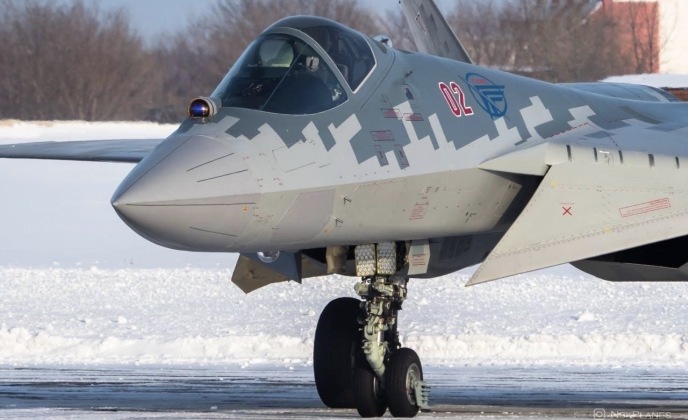
Indian media outlets have reported that a license production deal could begin with the sale of two squadrons of Su-57s built in Russia, each of 20 fighters, which would be followed by a further five squadrons produced locally. India’s only high profile fighter procurement made in the last decade has been for 36 French Rafale fighters, with the perceived serious underperformance of these aircraft, which saw between one and four shot down, during clashes with Pakistan in May, thought to have been a major factor increasing interest in the Su-57 and in expanding the S-400 arsenal. As neighbouring China is poised to begin fielding sixth generation fighters from the early 2030s, a Su-57 fleet paired with a network of S-400 systems is likely to be the most formidable counter-capability India will be able to field for the foreseeable future. The expected availability of a number of sixth generation technologies for the Su-57 from the mid-2030s is expected to allow the aircraft to remain viable into the sixth generation era.
