


News
F-18E/F Super Hornets Simulate Strikes on Venezuela From U.S. Navy’s Largest Supercarrier
Nov
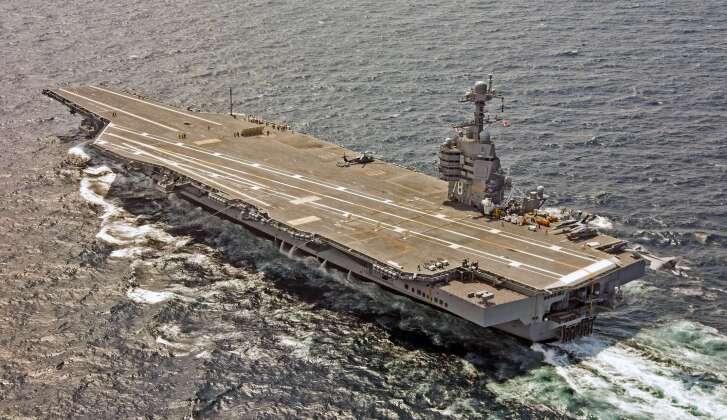
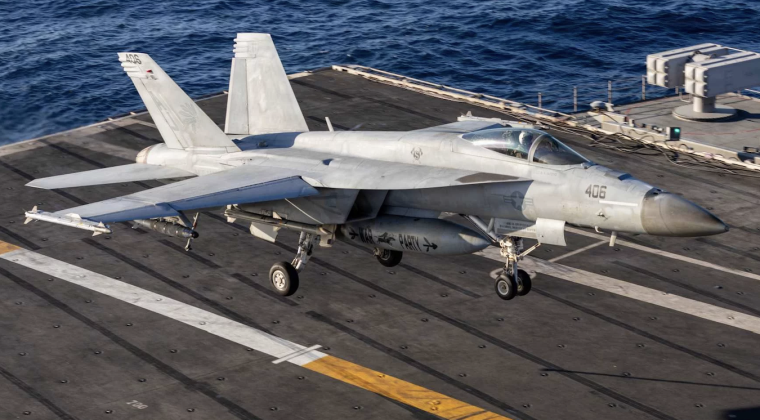
Images released by the U.S. Department of War have confirmed that the air wing of the U.S. Navy supercarrier USS Gerald Ford has begun to conduct flight operations in the Caribbean Sea, following the carrier group’s redeployment to the region as part of efforts to increase military pressure on Venezuela. U.S. officials describe the operations part of an expanded readiness posture, with the F-18E/F fighters onboard reported to be simulating attacks on Venezuelan targets. Delays integrating the F-35C fifth generation fighter with the USS Gerald Ford’s catapult launch system have restricted the supercarrier to operating a combat air wing exclusively made up of F-18E/F fighters and E/A-18G electronic attack jets, although the deployment of F-35s from newly opened facilities on Puerto Rico ensures that their unique capabilities will be available to support combat operations should Washington proceed to attack its southern neighbour.
The USS Gerald Ford is one of just three aircraft carriers with electromagnetic catapult launch systems, alongside the Chinese carriers Fujian and Sichuan, which allows it to launch aircraft with significantly greater weights. The F-18E/F has formed the backbone of the Navy’s fighter fleet for close to two decades, and is an enhanced fourth generation fighter initially intended as a stopgap between the Cold War era F-14 and F-18C/D, and the next generation F-35C. Major delays to the development of the F-35C resulted in an expansion of F-18E/F production by 12 years, with the Navy now fielding over 700 Super Hornets and their close derivatives the E/A-18G. The capabilities of most F-18E/Fs in the fleet are considered increasingly out of date today, however, with only a small portion of the fleet having been brought up to the much more costly F-18E/F Block 3 standard with a modern electronically scanned array radar and ‘4+ generation’ avionics.
Alongside the carrier group led by the USS Gerald Ford, the U.S. Armed Forces have deployed B-52H Stratofortress and B-1B Lancer intercontinental range strategic bombers for simulated strikes and Bomber Attack Demonstrations over the Caribbean Sea, with the aircraft having staged multiple shows of force in the region from mid-October. These have included flights with transporters turned off to conduct stimulated attacks on Venezuelan targets. Venezuela has responded to the U.S. military buildup by staging military exercises, and by deploying its Su-30MK2 fighter aircraft for long range patrols and shows of force. The Su-30MK2 is a larger, more heavily armed and longer ranged fighter than the F-18, but lacks comparable advanced avionics and weaponry to the Navy’s newest F-18E/F Block 3 variants. Despite a suspension of major defence procurements after the death of President Hugo Chavez in 2013, Venezuela’s air defences are still considered the most formidable Latin America, with the S-300VM long range surface-to-air missile system forming the backbone of a formidable ground-based network.
